This guest blog by Senior Lecturer Dr Ellen Williams is the second of two pieces about a recent final-year field trip to South Africa.
Undertaken with , it saw 26 students studying Animal Behaviour and Welfare, Bioveterinary Science, Veterinary Nursing, Wildlife Conservation, and Zoology spend just under two weeks in the country – enjoying a diverse range of studies and some of the country’s fantastic flora and fauna.
See the first blog here.
It is always bittersweet leaving the Wild Connection camp at Nambiti Game Reserve. Goodbyes are sad but the students had a whole new adventure ahead of them, including a four and a half mile hike through a gorgeous valley on the way.
We met some of the Zingela team at the gate and piled into their big truck. A couple of our group couldn’t make the walk so they sat in relative comfort for the scenic route round to the reserve, while the rest of us trundled off to start the walk. The walk takes you down through a valley that is owned by the local community.
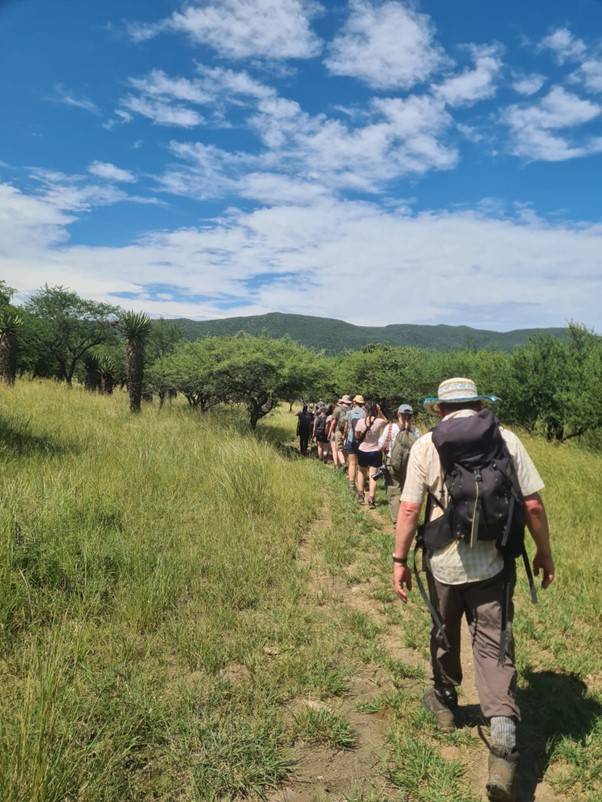
Not a bad place for a hike – apart from the odd tick waving at you from the grass!
Loaded with snacks, and covered with suncream and tick repellent, we set off. The students were in great spirits, excited for the journey ahead, and as always, with eyes peeled for wildlife and photo opportunities.
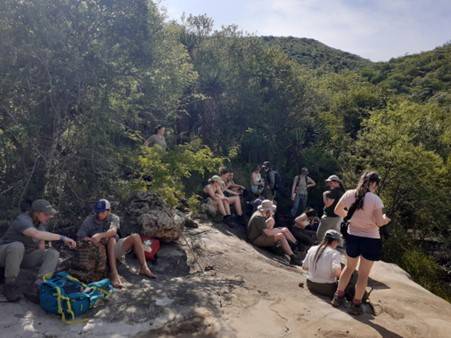
Stopping for a quick shade and view break on the way to Zingela (Photo credit: Andy Cherrill)
As always, too, there were recuperation breaks along the way, and this gave us a chance to pick up Steve, our stick for the week.
Now last year we lost our stick, Vicky, before we had even reached the river, so this year the challenge was to at least get Steve to camp. Steve was to stay with us for the week, joining all of the activities the students did. We also got to hear stories about Zulu culture in relation to the olive trees, from our fabulous guide, Jugs.
The Zulu community traditionally use branches from the wild olive tree to help carry the spirits of deceased loved ones back home. We took a small olive branch on to the camp with us, alongside Steve!
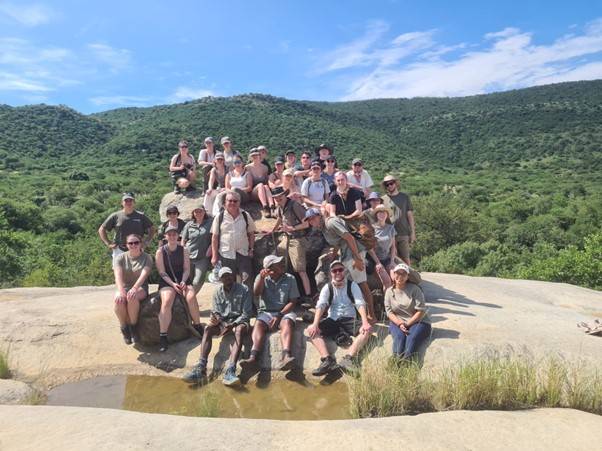
The traditional group on the rock shot!
The final stage in the journey to Zingela is crossing the River Tugela; which was accomplished by dinghies.
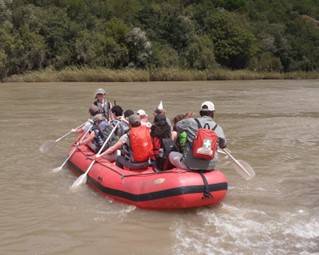
Full steam ahead, the students help Jugs, one of the guides, to paddle over to Main Camp (Photo credit: Andy Cherrill)
I always love seeing everyone’s reaction to arriving into camp for the first time. The beautiful setting is always greeted by ‘wow!’. This year, students even described it as ‘very bouije!’
We all had a nice cold drink before unpacking and settling into our new home for the next week.
The first evening, the students were split into four groups and were tasked with making their first dinner, a potjie. A potjie is a traditional South African dish, cooked in a cast iron pot on open coals. That task sounds simple, but the challenge was increased by them needing to start their fire with only one match. And then we threw an added layer of competition in – there would be a taste testing at the end! That was it, the gauntlet was thrown and the cook-off was ON!
All of the teams produced edible food, which is always a bonus! The winning team did up the ante though, by putting a can of local beer in the pot! Yum!

The winning team prepping their potjie (Photo credit: Nick Covarr)
Suitably full, we had a welcome presentation from Dr. Peter Calverly, the site owner and manager, and the students were given their itinerary for the week. As always, it was action packed and an early night was on the cards for most people so they could ready themselves for the week ahead.

The itinerary was busy but the students could not wait for the adventure ahead!
Camera traps
One of our first tasks was to set up camera traps to allow us to start capturing data on the animals on site – mainly which species were present, which individuals were present (if known) and where they were seen.
I had high hopes for a leopard so we embarked on quite an epic trip. The task was relatively simple – split into two groups and place out eight camera traps. We DID succeed in placing all of the camera traps out, and one of the groups had installed all of their camera traps successfully.
Unfortunately my group didn’t do quite so well and we only had one success! Nevertheless, lots of animals were spotted on the traps including giraffe and the baboons.

One of the students with the just set up camera traps – we were hopeful of leopards!

No leopards but we were lucky enough to capture a black-backed jackal, many giraffe and a troop of baboons travelling through (Photo credit: Ellie Cox)
Much like Nambiti, the true joy of South Africa is the flexible itinerary. We were out to install camera traps but that didn’t stop us checking out other things on our route – giraffe, baboons (at a distance – I am pretty sure I saw only rocks) and a white-fronted bee eater. The opportunity to immerse yourself in wildlife is just fabulous.
Scales, feathers and fins
On our second full day we were joined by the Kyle family.
Dr. Scotty Kyle and Dr. Kirsty Kyle gave us two lectures; one on the dangerous and not so dangerous reptiles and spiders that we might be going to share the next week with, and one on bird ringing.
After the first lecture on reptiles and spiders, we were given the opportunity to try our hand at fishing. This year we were using rods rather than nets, and were fishing further down the site. There were keen fisher-people in our midst and so they set out on their mission to capture fish. This is part of the fish monitoring programme being undertaken at the site.
Any captured fish that weren’t already tagged were tagged and then released. These would then be part of the monitored population as part of the , a tool which uses fish behaviour to monitor river flow and water quality.

Hanging out with the fishing rods down by James Camp (Photo Credit: Andy Cherrill)
Whilst we were catching fish, Kirsty and her team were busy trying to catch birds as part of the bird ringing programme at Zingela. Whilst we were there she caught two birds. After a great talk about the bird ringing programme and the number of birds caught to date, she led us through the process of catching, handling, taking measurements and ringing birds.
Two birds had been caught, an African pied wagtail and a Cape wagtail. Neither of them were previously ringed so both of these were ringed. Kirsty took a number of details including length of the wing, tail and tarsus length, along with bird age (adult/juvenile), bird sex (if definitely known) and bird weight. After they were ringed, Kirsty then let them go and off they flew, chirping away, to continue their life in the sunshine.

The African pied wagtail (Photo credit: Ellie Cox)

The Cape wagtail after it had been ringed (Photo credit: Ellie Cox)
The fishing rods were left out over lunch and in the afternoon Scotty gave a short talk on the fish monitoring programme at Zingela, including introducing the students to the RFID tags which mean that even without additional captures, all of the fish which have been tagged are continuing to contribute important data.
Some of the students then also had an opportunity to cool off by jumping into the Tugela river to get some water samples for a mini stream assessment scoring system (miniSASS) assessment. Once samples were caught, the groups on land set about recording aquatic invertebrates, which provides another means of assessing aquatic system health. A joint effort between Zingela staff and students meant that two fish were caught, which is significantly more than we managed last year when we seemed only to catch ourselves!
Whilst that was going on, a few of the group went off for a very hot hike to see the trees in the reserve. Zingela is full of many beautiful trees and as our resident forester, Nick wanted an opportunity to learn more about the area.
Scotty’s wife, Di, was on hand, along with Kirsty, to give us a fab tour of the area, including showing us a terrifying looking nettle tree!

One of the Shepherd’s tree photos at Zingela
Giraffe tracking
They feature in the Zingela logo - and they are an absolutely integral part of the Zingela story – so a really important part of the week was giraffe tracking.
Giraffe had featured in some of the ‘must-see’ lists the students had given me in Nambiti and so this task was met with much excitement. Because Zingela does not have dangerous animals, much of what we do there is on foot. The giraffe tracking involves going out for a (quiet) walk, identifying known giraffe and then, if you are lucky enough to find new giraffe, taking photos of them. The giraffe inventory is huge (104 pages long!) but we did get the chance to spot a couple of brand-new arrivals - estimated to be about one week old – watching them run through the bush together was pretty special.

Giraffe spotting – we were lucky enough to see two adult females with their brand new calves! (Photo credit: Ellie Cox)
Most animals have just one collective noun, but giraffe are a bit special, they have three! A stationary group of giraffe is called a Tower or a Kaleidoscope (so named because of their visual patterns) whilst a moving group of giraffe is called a Journey. Spending time quietly walking through the African bush gives you lots of time to learn new things and take in the sights and sounds.
Pitfall traps
Zingela focuses very much on some of the more understudied species and setting up pitfall traps for species monitoring is an important part of the time at the reserve.
In previous years we have had to dig new pitfall traps but this year, luckily, the traps were already in place and we just had to reopen them for a new phase of monitoring. Ari, one of the guides, looks after the traps, making sure they are well maintained and have the appropriate vegetation in, and then monitoring species found daily whilst they are open.
The monitoring areas are set up in a Y shape, with the stick of the Y pointing North. They consist of pieces of black board at 90 degrees to the ground with buckets and funnel traps along either side and a long funnel trap at the end. The idea is that animals passing through the area will be captured either in a bucket or a funnel trap, and depending upon the location, Ari will be able to work out their direction of travel.

Getting the traps ready for monitoring over the next few days (Photo credit: Andy Cherrill)
They had been closed for a period of time before our arrival so they needed a refresh. There had been a not insignificant period of rainfall just before our arrival so the first task was to empty the buckets of water and the refill them with dry foliage. This serves both to protect them from the sun but also from other individuals in the traps, to reduce the risk of any animals being predated upon.
Once they are set, Ari and the students checked them morning and night for anything that had landed in them. It’s possible for all sorts of surprises to be in the traps, including snakes, frogs, toads, scorpions, a whole array of invertebrates and sometimes even small mammals like mice.

A scorpion found in one of the pitfall traps (Photo credit: Andy Cherrill)
Reserve management
I’m not a very proficient gardener because I am never entirely sure what is a wanted flower and what is a flower in the wrong place (ergo, a weed) but at Zingela there is no such fear. The site is 12.5 thousand acres of African bushveld and so it is the perfect place for unwanted flora, so good reserve management is absolutely key in ensuring that there is a broad range of plant diversity and enough resources to support the local wildlife. Managing unwanted flora is extremely important and big groups such as ours help to assist in such tasks.
One of the main culprits is prickly pear. Whilst it produces a stunning flower which tastes really good as coulis, it is an absolute menace for the reserve as it regrows from just a tiny piece of leaf – and being a drought-resistant species means it can easily excel where other species struggle. It then ends up forming impenetrable thickets and outcompeting other native species.
The task was to eradicate as much as possible, which is really quite therapeutic. Prickly pear gives you a real fight so pulling those out really helps you to get rid of any pent up anger!
Adventure sport time: Kayaking and Abseiling
The kayaking was a welcome reprieve on the fourth day. The sun was beating down and whilst that was absolutely glorious, the thought of being soaking wet in a boat was even more so! As we were a big group it was quite the logistical mission to get students and boats to the launch point up stream.
In total we had two big red ribs (taking six to eight people) and four two/three man smaller boats. Everyone that wanted a paddle grabbed a paddle and one by one we shuffled the boats into the water. It’s all very dignified, honestly! We hadn’t even got all of our boats into the water when one of the boats capsized, the Tugela river adventure was on! We careered down the rapids, led by Jugs and Ari. There was much screaming and laughter as boats bobbed and water was splashed over us. We stopped for a break half way down and then swapped boats so that everyone who fancied paddling in a smaller boat had an opportunity to.

Sadly no boating action shots, but this is the river we paddled down (Photo credit: Huw Williams)
We navigated our way largely unscathed (a couple of boats may have ended up slightly teetering in reeds or on rocks – blame the navigators!) through the rapids and came to a stop at James camp. Ari and the team then set us up a nice fire and we had a sundowner by the side of river, pure bliss! Not a group to stay put for long, we also had some of the students doing a whole host of gymnastics, which culminated in a wheelbarrow race! We have hidden talent amongst this cohort – but certainly not mine – it turns out wheelbarrow races are significantly harder as an adult! Andy Cherrill and Nick Covarr (my fellow staff on the trip) on the other hand were basically semi-pro, they clattered through one of the pairs in the race and ended up with a fairly impressive podium finish (second place)!

The start of the wheelbarrow racing! (Photo credit: Huw Williams)
Not for the fainthearted, the abseiling was a serious challenge for some of the group, myself very much included.
There was definitely a mix of excitement and pure fear. There were white knuckles and shaking legs but we were in the hands of the most incredible guides and the students were so supportive of each other.
One by one, everyone who wanted a go was strapped into the harness and asked to lean backwards over the rock edge, before gently lowering themselves down to a ledge. Woops and cheers could be heard from afar. The view from 28 metres is up is absolutely stunning and the students who were able to enjoy the view on the way down told me it was equally beautiful. The abseil wasn’t for everyone but everyone came along and enjoyed the view from the top.

One of the students starting the abseil, in the safe hands of Jugs (Photo Credit: Tamira Dixon)
Veterinary outreach
This is always a firm favourite for the students as we head out into the local villages to help Zingela with part of their veterinary outreach programme.
The Zingela reserve have been working with the local community for several years now to help to support improved livestock health and welfare. This year we were giving goats tick and worm treatment, along with a general health check. There is currently a foot and mouth crisis in KwaZulu-Natal so in addition to body condition scoring and checking for injuries and assessing foot health -foot rot can be quite a big problem - we also needed to check the mouths and feet for lesions which could be indicative of foot and mouth disease.
It was an early start but everyone was fully ready for the day ahead.
Well, they thought they were ready - I am not sure anyone quite imagined what was in store for them! The task sounds simple, catch a goat, give it a health check and then hold it while Jenny injectes it with a wormer. But add in extreme heat and a very large number of goats you have got quite the chaotic scene. Students became pretty adept at catching goats as they came flying past them, sometimes managing to grab hold of two or three. Over the two days we managed to assist with more than 300 goats!
The local farmers had kindly brought their goats in which made things easier but unfortunately we ran out of vaccines because we were getting too efficient!
During the second day we saw quite a few goats with split hooves and/or overgrown hooves. The split hooves had likely come about as a past problem – perhaps poor nutrition or bad weather conditions that meant the hooves hadn’t grown properly, and they were now starting to peel off. Boggy grass from lots of rain is a very likely culprit, especially when it is the whole herd. This can be treated by trimming the hoof, however this hadn’t been performed. As Jenny is just one person it wasn’t possible for her to undertake treatment for all of the goats, so instead she taught the farmers how to do it themselves, with the tools they had available. Community education is so important as it equips people with the knowledge to make long term management changes which will have significant benefits to the animals for the future.

One of the groups of goats that we were helping to catch (Photo credit: Saffron Banks)
The final firepit
On the last night we had our final firepit of Zingela and also of the two weeks. This is the time that Steve should have ended his journey. Unfortunately, Steve was MIA somewhere along the route. But Ari, one of the fabulous Zingela team, was on hand to help. He thankfully helped to locate Steve’s Uncle.

Steve sadly didn’t make it but one of the last known sightings was inside the Zingela Jenga set! Photo credit: Saffron Banks
As with Nambiti, we did a final induku and everyone reflected on their week, sharing their highlight, their lowlight (limited) and their favourite memory with Steve.
To be honest the Steve memories were variable in quality but some students had become quite attached to him!
As always, for me my favourite part of this trip is seeing Africa through the eyes of the students, for most this was their first experience of this stunning place.
Students reflected upon the fact they had spent another week in a truly amazing part of the world, they’d had the opportunity to bond with others and build new relationships (some of them started out as strangers and finished as firm friends), they felt like they made a genuinely valuable contribution when helping with the goats in the community.
We’d been fortunate enough to have an extra few days at Zingela as our travel plans had been disrupted and whilst some of the students were ready to head home, conscious of the many looming deadlines they had when they returned to the university, a number of them were already making plans to come back!

The final firepit (Photo credit: Nick Covarr)
On the last night, one of the students (an artist hiding in plain sight) had done a poem about their experiences to give to Peter.
To preserve their anonymity we’ll use their initials only, but FJG has an incredible talent. Certainly far greater than that of Nick, Andy or myself, as we discovered when we tried to create an impromptu birthday card!

Banksy is probably quite safe – this was our attempt at a birthday card, retelling the story of the how one of the Nambiti groups found themselves unexpectedly between lion and elephants on the night drive!
Thank you South Africa for leaving our students with more once-in-a-lifetime memories and to the GAP Africa Projects team for always providing such a packed itinerary.
I’ll sign off with the words in this poem, as this so beautifully expresses The Zingela Journey.
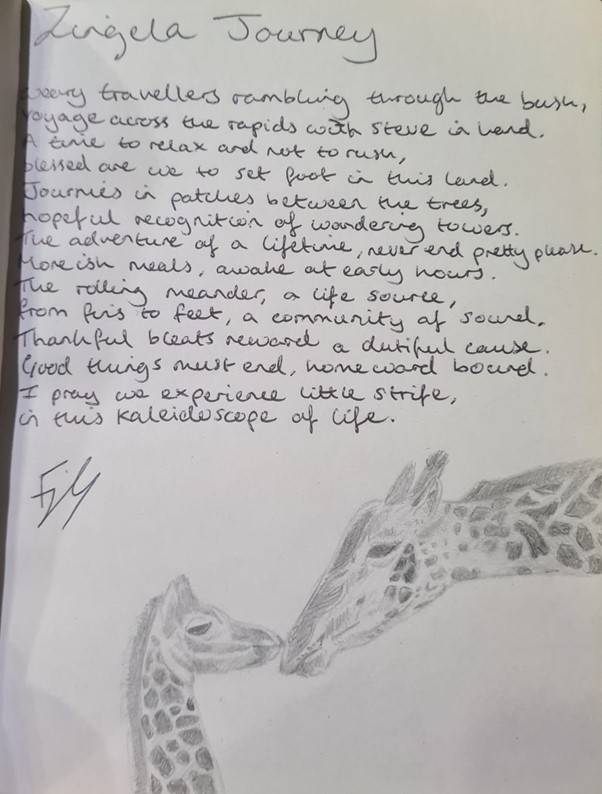
Zingela Journey - by FJG (Harper Adams Student, 2026)
Weary travellers rambling through the bush,
Voyage across the rapids with Steve in hand.
A time to relax and not to rush,
Blessed are we to set foot in this level.
Journeys in patches between the trees,
Hopeful recognition of wondering towers.
The adventure of a lifetime, never end pretty please.
Moreish meals, awake at early hours.
The rolling meander, a life source,
From fins to feet, a community of sound.
Thankful bleats reward a dutiful cause.
Good things must end, homeward bound.
I pray we experience little strife,
In this kaleidoscope of life.

 Blog: Day offers care-experienced young people an introduction to university life
A day aimed at raising awareness of higher education for care-experienced young people has been held at Harper Adam …
Posted
Yesterday
Blog: Day offers care-experienced young people an introduction to university life
A day aimed at raising awareness of higher education for care-experienced young people has been held at Harper Adam …
Posted
Yesterday